

Full Name in Ukrainian: Володимир Петрович Юрченко; Володимир Юрченко
Full Name in English: : Volodymyr Petrovych Yurchenko; Volodymyr Yurchenko
Data of Birth: Cir. 1926
Place of Birth: Rososha
Raion: Lypovets raion
Oblast: Vinnytsia oblast
Country: Ukraine
Copy of original: Yes
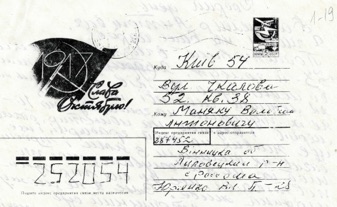
Envelope: Yes
Number of pages: 4
Keywords: Ukraine--History--Famine, 1932-1933--Personal narratives; Famines--Ukraine--History--Sources; Famine victims; Holodomor; Голодомор; perpetrators; search brigades; cruelty; burial; burial brigades; mass mortality; cannibalism; concentration camp prisoner; Communists; Komsomol.
Notes: An abridged excerpt from Volodymyr Yurchenko’s letter is published in 33ii: holod: Narodna Knyha-Memorial. Kyiv: Radiansky pysmennyk, 1991, p.99.
Accession Number: 2007.2-1008


SYNOPSIS

The UCRDC depends on voluntary donations – both individual and institutional - for its financing.
It provides receipts for tax purposes.

-
‣Home
Volodymyr Yurchenko was 7 years old at the time of the Holodomor which he survived in the village of Rosocha of Lypovets raion or Vinnytsia oblast. He recalls how a burial brigade was collecting people who were still alive and taking them to the cemetery. Some of those people managed to escape from the burial pit and survived. Yurchenko compares the actions of search brigades composed of Communists and Komsomol members to a “Judgement Day” and remembers the insensitivity of the head of the local Komsomol organization who mocked a couple (a man and a woman), who died on the steps of a church.
As a prisoner in the Nazi concentration camp at 16, he met all kinds of people, including antifascist Communists who, he implies, were an entirely different sort of people than the ones that he knew in Ukraine. He questions, sarcastically, why the head of the Communist Party of Ukraine Shcherbytsky speaks Russian instead of Ukrainian and why he was awarded the Hero [of Socialist Labour] rank. Yurchenko also opposes the construction of the nuclear power plants in Ukraine, because of the Chernobyl tragedy.
Speaking of the number of people who died in his village during the Holodomor, he cites recollections of his mother and uncle, as well as some other people in the village. Apparently, 113 people died during the Holodomor in only the second section of his village which had eight sections in all.