


Full Name in Ukrainian: Володимир Петрович Яромов
Full Name in English: : Volodymyr Yaromov
Data of Birth: 1915
Place of Birth: Onatskivtsi
Raion: Polonne raion
Oblast: Vinnytsia oblast (currently Khmelnytsky oblast)
Country: Ukraine
Copy of original: Yes
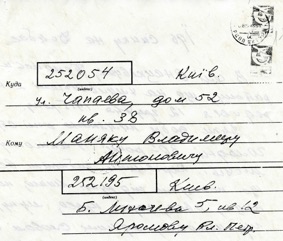
Envelope: Yes
Number of pages: 4
Keywords: Ukraine--History--Famine, 1932-1933--Personal narratives; Famines--Ukraine--History--Sources; Famine victims; Holodomor; Голодомор; collectivization; perpetrators; activists; grain requisitioning; food substitution; survival strategies; burial; travelling for work; Nazi collaborator; Donbas.
Notes: Abridged and edited transcription of Volodymyr Yaromov’s letter, with additional details about his life in the Donbas, is published in 33ii: holod. Narodna Knyha-Memorial, 1991, p. 102.
Accession Number: 2007.2-1026

SYNOPSIS

The UCRDC depends on voluntary donations – both individual and institutional - for its financing.
It provides receipts for tax purposes.

-
‣Home
Volodymyr Yaromov was born in 1915 in the village of Onatskivtsi in Polonne raion of Vinnytsia oblast (currently Khmelnytsky oblast).
He recalls that the activists of the search brigade took everything edible from the peasants in their village. They came to Volodymyr’s parents’ house with a rifle and demanded that his father, Petro, deliver 70 poods (1 pood= 16.3807 kg) of grain “to the state.” Petro noted that he had delivered his previously assigned quota of grain two months earlier and the head of the village council Yukhym “Harmyder” replied that now he was assigned a new quota. Activists took all wheat, rye, flour and even seed grain from the family. When Volodymyr started crying and asked Yukhym to leave some millet for his sickly mother, he was told to shut up or he would get slapped around.
Volodymyr’s elementary school teacher’s daughter named Liuba stopped by his ransacked house to talk to his mother. Liuba suggested that Volodymyr come with her family to the Donbas. Her husband was working at a mine in Rutchenkovo (currently Donetsk oblast) and could help Volodymyr find a job. His mother told Yaromov to go to the Donbas.
From the version of the letter published in the memorial book, we learn that Volodymyr moved to the Donbas, found a job, and kept sending toasted bread back home, and thus saved himself and his parents from starving to death.
During WWII, Yukhym “Harmyder” became a Nazi collaborator and executed four Jewish families from Onatskivtsi, while Volodymyr became a commander of a Soviet partisan unit.