


Full Name in Ukrainian: Андрей Тютюнник
Full Name in English: Andrei Tiutiunnyk
Data of Birth: 1925
Place of Birth: Tekucha
Raion: Uman raion
Oblast: Kyiv oblast (currently Cherkasy oblast)
Country: Ukraine
Copy of original: Yes
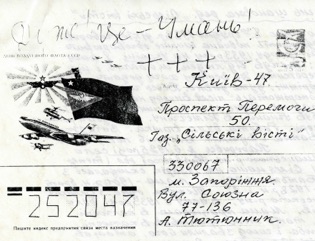
Envelope: Yes
Number of pages: 5
Keywords: Ukraine--History--Famine, 1932-1933--Personal narratives; Famines--Ukraine--History--Sources; Famine victims; Holodomor; Голодомор; food substitution; survival strategies; physical deterioration; burial brigades; burial; mass mortality; nursery-orphanage; ration; horses; cannibalism; memorialization.
Notes: An abridged excerpt from Andrei Tiutiunnyk’s letter is published in 33ii: Holod: Narodna Knyha-Memorial. Kyiv: Radiansky pysmennyk, p.56..
Accession Number: 2007.2-1030


SYNOPSIS

The UCRDC depends on voluntary donations – both individual and institutional - for its financing.
It provides receipts for tax purposes.


-
‣Home
Andrei Tiutiunnyk was born in 1925 and survived the Holodomor as a child in the village of Tekucha in Uman raion in Kyiv oblast (currently Cherkasy oblast). He had one more sibling, brother Pavlusha, born in 1928. At the age of 17, Andrei was taken to Germany as an Ostarbeiter, where he lived in a camp and worked hard unloading cement, lime and coal. He left his village in the 1960s and moved to Zaporizhzhia, where he worked at the Zaporizhstal plant.
During the Holodomor, Andrei’s father’s sickness was aggravated by starvation and rendered him disabled. As a result, his mother was the only one in the family who worked and received 2 kg of flour per working person per week. They had to ration it, and only Andrei’s father got bread baked out of pure flour once a week. The rest of the family had to mix the remaining flour with weeds. Andrei and his mother, along with other locals, were catching frogs and collecting mussels in the Yatran river and cooking them. That, however, was not enough, as the legs of both children in the family began to swell. Mother was terrified of this sign of severe malnutrition and begged the head of the collective farm to accept the children into the collective farm’s nursery-orphanage (yasla-internat). There, both boys were given a bowl of watery flour-based soup and a thin slice of bread, approximately 100 – 150 gm each.
On Andrei’s initiative, the children were saving the bread to bring it home for their ailing father. On their daily trips to the nursery-orphanage, the children witnessed people with severe signs of deterioration, swollen, unable to walk, crawling and dying on the streets. Many also died in their houses. The head of the village council ordered all five collective farms in the village to form two-person crews to pick up the dead and transport them to the cemetery. There was a burial brigade at the cemetery, digging mass graves, piling up corpses in those graves or next to a grave which got filled until the next grave was dug up. Some body collectors had no problem with dragging adults and even children who were still alive to the cemetery. There were cases of cannibalism in the village and Andrei knew some of the cannibals. His uncle was once transporting a caught cannibal to Uman. On the road they encountered Zatonsky, a minister of the Soviet Ukrainian government, who reportedly was shocked to learn about cannibalism in villages.
The author also mentions that people could tear apart a dead or even a half-dead horse, in minutes, and all the dogs were also eaten. One especially cruel local guard of the wheat and rye fields would tie to his horse and drag people that he caught trying to steal some grain. He became the head of the local police during the Nazi occupation. Tiutiunnyk questions why so many people had to die in his and many other villages in Ukraine while the flour was shipped abroad from Odesa, and why the Soviet leaders from Moscow showed no mercy to the starving and dying people of Ukraine. He demands that a monument to the victims be erected in Kyiv.