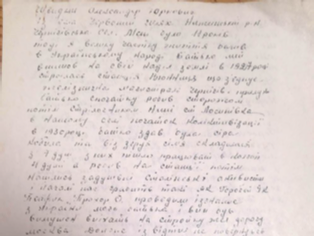


Full Name in Ukrainian: Олександр Юркович Швидни
Full Name in English: Оleksandr Shvydny
Data of Birth: unknown
Place of Birth: Chervony Shliakh (currently Losynivka)
Raion: Humetsky, Eugene
Oblast: Chernihiv oblast
Country: Ukraine
Copy of original: Yes
Envelope: No
Number of pages: 4
Keywords: Ukraine--History--Famine, 1932-1933--Personal narratives; Famines--Ukraine--History--Sources; Famine victims; Holodomor; family mortality; Голодомор; search brigades; extrajudicial violence; murder; kulaks; perpetrators; activists; food substitution; burial brigades; grave diggers; food substitution; arbitrary prosecution; railway.
Notes: Abridged and edited transcription of Oleksandr Shvydny’s letter is published as “Oleksandr Shvydkyy” in 33ii: holod: Narodna Knyha-Memorial. Kyiv: Radiansky pysmennyk, 1991, p. 560.


SYNOPSIS

The UCRDC depends on voluntary donations – both individual and institutional - for its financing.
It provides receipts for tax purposes.


Оleksandr Shvydny recalls events that occurred in the villages of Chervony Shliakh (currently Losynivka), Viunnytsia (Losynivka station), and Nosivka, all in Nizhyn raion, Chernihiv oblast, during the Holodomor.
He was one of seven children in the family. His father worked at Viunnytsia (now Losynika) railway station and had a land plot from 1927. He owned a mare and a wagon that he donated to the collective farm after it was created in the village in 1930. Four of his seven children began working on the collective farm. Shvydny mentions that some people hid grain from searches, engaged in sabotage, and did not deliver the required grain quotas. This was not the case with Shvydny’s father, who successfully paid in-kind tax in 1929-1931.
Local “Stalin’s activists,” Horobei, Petryk and Prokhor began persecuting Shvydny’s father “out of spite.” He was labeled a kulak, although he was hardly even a middling peasant, and was forced to leave the village and even Ukraine. He went to work on the construction of the Moscow – Donbas railroad and never returned.
His family, left behind, was pillaged by a search brigade. Members of the brigade, Petryk and Prokhor, took all the remaining food away in the spring of 1932. Shvydny writes that in the fall of 1932, starving people from the Poltava region began moving through Chervony Shliakh and dying on their way. By 1933, starvation engulfed Losynivka and nearby villages.
Survival in the villages depended to a large degree on the actions of local leaders. Some were more merciful, such as the head of the collective farm in Chervony Shliakh, Bondar, who ensured that people were fed some gruel (zatyrka) after Petrovsky visited the village and likely authorized to use some grain to feed the population. Similarly, Serhii Shumeiko in Nosivka took steps to provide some food, was not excessively harsh towards those labeled kulaks, and allowed a local church to remain open. Shvydny claims that no one died of starvation in Chervony Shliakh. Others were cruel, committed violent acts and even extrajudicial killings. Starvation led some people to acts of cannibalism, as occurred in Losynivka.
Shvydny also mentions that “kulak gangs” operated in the village of Losynivka in 1928-1929. They set properties on fire at night. In Chervony Shliakh, the head of the collective farm, Kh. Bondar, and Ivan Horobei were shot through the window by such a gang.
Shvydny names several “activists” from search brigades and grave diggers in Chervony Shliakh and Losynivka who distinguished themselves by their fervor and cruelty in carrying out their duties. In the end, he notes that either Stalin or Kosior made them do it.
-
‣Home