


Full Name in Ukrainian: М.Г. Шестопаль
Full Name in English: M.H. Shestopal
Data of Birth: 1923
Place of Birth: Sloboda (Zhydivchyk, Budionivka)
Raion: Tetiiv raion (currently Bila Tserkva raion)
Oblast: Kyiv oblast
Country: Ukraine
Copy of original: Yes
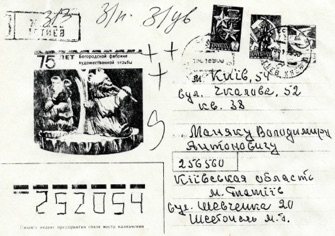
Envelope: Yes
Number of pages: 5
Keywords: Ukraine--History--Famine, 1932-1933--Personal narratives; Famines--Ukraine--History--Sources; Famine victims; Holodomor; Голодомор; food substitution; survival strategies; search brigades; perpetrators; physical deterioration; burial brigades; burial; family mortality; school; teacher; ration; orphan; childhood; semiliterate; ditties; horses; memorialization.
Notes: An abridged excerpt from M.H. Shestopal’s letter is published in 33ii: Holod: Narodna Knyha-Memorial. Kyiv: Radiansky pysmennyk, p.340.
Accession Number: 2007.2-4018


SYNOPSIS

The UCRDC depends on voluntary donations – both individual and institutional - for its financing.
It provides receipts for tax purposes.


-
‣Home
M. Shestopal survived the Holodomor as a child in the village of Sloboda (renamed as Zhydivchyk in the 1920s and then Budionivka circa 1930), in Tetiiv raion, Kyiv oblast (currently Bila Tserkva raion, Kyiv oblast; see https://ukrgenealogy.com.ua/viewtopic.php?t=12309).
Shestopal criticizes the letter of O. Stakhova, who apparently was an activist of a search brigade during the Holodomor. Hers, and a few other letters that the author mentions, were sent to the editorial board of Silski Visti and published in the newspaper. Shestopal compares perpetrators like Stakhova, the search brigades in general, to “whores” and locusts that swept everything from families and homes – food, home-made medicinal ointments, and clothes - leaving people to die. Shestopal tried to save his father by feeding him soup, made of goosefoot, with a straw. Nevertheless, his father died in terrible convulsions and got buried in one of many pits scattered throughout the village, leaving Shestopal an orphan. Shestopal father’s makeshift funeral shroud made from homespun hemp textile got stolen overnight because the pit was not yet filled with earth. Burial brigades dragged people who were still alive to the burial pits. Some were dying in the pits, some managed to crawl out of the grave and survive to live a long life afterwards.
Starving Shestopal and others in the village tried to use weeds, straw, meat of dead horses, pets, frogs and turtles (from the Roska river), and eggs of wild birds. Once he tried to collect a fistful of grains in the field but got caught, beat up and thrown into a pit. He also recalls working as a child in the collective farm and receiving only 20-50 gm of bread per day for his work. So many details in Shestopal’s letter are evidence of starvation and cruelty that he and other victims and survivors experienced. He cites a couple of ditties that were sung in the village and hinted at deprivation experienced by the villagers and hypocrisy of the political regime.
Shestopal recalls that in school, they were given hot water with salt or, on rare occasions, with some meat. His supportive teacher tried to instill hope in students and encouraged them to write letters to the “leaders” like Kaganovich, Voroshylov and Molotov. Shestopal wrote a letter to Voroshylov but neither him nor his classmates ever got a response or any relief. The leaders remained “blind and deaf” to their suffering. At some point, the same teacher also told them to rip off and throw away the cover of their school workbooks with Volodymyr Sosiura’s poem on the cover. Shestopal mentions a memorial erected by a local man on the site of the Holodomor mass burials in the village. However, the epitaph does not contain the word “famine,” which is a shame, in Shestopal’s opinion. He insists that the memorial book would be an important contribution into making sure that the horrors of the Holodomor or war never happen again and believes that famine is worse than war.