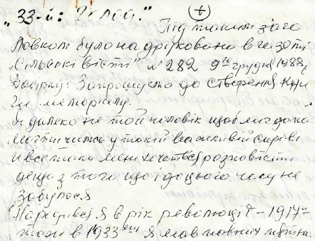



Full Name in Ukrainian: Микола Пуд; Микола Степанович Пуд
Full Name in English: Mykola Pud
Data of Birth: 1917
Place of Birth: Vilshane
Raion: Sosnytstia (currently Koriukivka raion)
Oblast: Chernihiv oblast
Country: Ukraine
Copy of original: Yes
Envelope: No
Number of pages: 62
Keywords: Ukraine--History--Famine, 1932-1933--Personal narratives; Famines--Ukraine--History--Sources; Famine victims; Holodomor; Голодомор; collectivization; dekulakization; dukulakization; family mortality; perpetrators; activists; requisitioning; food substitution; survival strategies; cows; horses; poverty; childhood; trauma; WWII veteran; disabled.
Notes: Abridged and edited transcription of Mykola Pud’s letter is published in 33ii: Holod: Narodna Knyha-Memorial. Kyiv: Radiansky pysmennyk, 1991, pp. 564-569.
Accession Number: 2007.2 -7007


SYNOPSIS

The UCRDC depends on voluntary donations – both individual and institutional - for its financing.
It provides receipts for tax purposes.


-
‣Home
Mykola Pud lived his whole life, except for the eight years when he served in the army in 1938-1946, in the village of Vilshane in Sosnytsia raion (now Koriukivka raion) in Chernihiv oblast. He worked as a cow shepherd during the Holodomor. His observations concern the unfairness of the process whereby individuals or groups were labeled as “kulaks,” illustrated by the fact that the last “kulak” family dekulakized in his village was his own - a rather poor family. His father died, and his mother, a widow with six children, used to serve as hired help to a local “pan” (large landowner) before the collectivization. Of special interest in Pud’s memoirs are his recollections about everyday life and traditions in his village before the Holodomor, and, during the Holodomor, а story about him saving his mother and siblings with hedgehog’s fat and ground squirrel meat. Their neighbour and local activist Ivan probably noticed that Mykola received payment in kind (potatoes and grain) for his work as a shepherd. As soon as Mykola brought the grain and potatoes that the villagers gave him home, the search brigade appeared and took it all away. Even after the Holodomor, Pud remembers living in extreme poverty. He was nicknamed “Didok” (Old Man) for his looks even though he was only 16. He believes that poverty and his looks are to blame for him staying single. In 1935-1938 he worked as a tractor driver and then was drafted. As a serviceman in the Red (later Soviet) army, he survived the evacuation of the Baltic fleet from Tallinn to Kronstadt in 1941 and then 900 days of the Siege of Leningrad. He got discharged only in 1946 as a person with disability (of the third group) and limited mobility, however, he worked as a mechanic until retirement.