


Full Name in Ukrainian: Генрих Підвисоцький; Генрих Подвысоцкий (рос.)
Full Name in English: Henrykh Pidvysotsky
Data of Birth: 1903
Place of Birth: Nova Hreblia
Raion: Kalynivka raion
Oblast: Vinnytsia oblast
Country: Ukraine
Copy of original: Yes
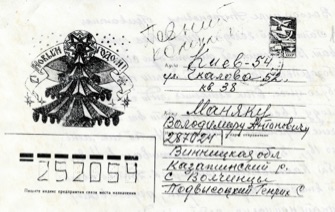
Envelope: Yes
Number of pages: 8
Keywords: Ukraine--History--Famine, 1932-1933--Personal narratives; Famines--Ukraine--History--Sources; Famine victims; Holodomor; Голодомор; deportation; ration; cannibalism; devastation; food substitution; horses; survival strategies; prosecution; 1937-1938 political repressions; GULAG; labour camp.
Notes: Abridged and edited transcription of Henrykh Pidvysotsky’s letter is published in 33ii: Holod: Narodna Knyha-Memorial. Kyiv: Radiansky pysmennyk, 1991, p. 78.
Accession Number: 2007.2 -1017


SYNOPSIS

The UCRDC depends on voluntary donations – both individual and institutional - for its financing.
It provides receipts for tax purposes.


-
‣Home
Henrykh Pidvysotsky was born cir. 1915. His memoir describes events that occurred between 1927-1947 and span the territory between his native village of Nova Hreblia in Kalynivka raion, Vinnytsia oblast in Ukraine to the Urals and Arkhangelsk in Russia. Somewhere in the middle of his letter he switches from Ukrainian into Russian.
Henrykh’s family was clearly rather poor. He mentions that they were relocated to the Urals sometime in 1927-1930, because their hamlet was destroyed and the land expropriated by the collective farm. They stayed in the Urals for a fall and then it took them almost a year to return on foot to Nova Hreblia. In 1931, when Henrykh was 16, his family lived in a rented room, his father was working as a security guard who also distributed hay. It was “garden hey,” and their family got by because his father was collecting dry peas left in it. Henrykh also mentions that at the time there were a lot of dead and swollen horses along the streets and roads in the village, and that he believed that horses were dying of starvation.
In the summer of 1932, Henrykh and his father already worked in the collective farm. They were barely surviving on a ration of 600 g of poor-quality bread, if they worked full day, and half of that, if their work was interrupted by rain. The bread was made of some “black mass” at the time when even horses were given better feed - some kind of corn bread and oil seed cakes. Onсе, Henrykh collapsed from exhaustion while at work. He thought he was going to die, but he survived and was given one day off work.
He denies that there was any kind of sabotage of the grain procurement by the party officials); there was no resistance to starvation whatsoever. People who tried to steal some edibles from the fields, were shot on the spot (like a boy who stole one beet) or received a 10-year sentence (like two women who stole a few ears of wheat). Henrykh witnessed unburied dead bodies of nine men laying by the road, encountered a family that he believed were cannibals, and noted that many houses were abandoned in the villages of Maly Cherniatyn and Velyky Cherniatyn. These things he observed in 1933 while travelling on foot from his place of work to his home or visiting his father who worked in the Kalynivka state farm (radhosp). Pidvysotsky emphasises throughout his letter that none of these terrible sights were terrifying to people, as such horror became routine at that time.
In 1937-1938, when he worked at a machine-building plant in Kyiv, he got arrested, and after a stay at Lukianivska jail in Kyiv, deported to a forced labour camp in Arkhangelsk oblast of Russia. He served an approximately 10-year sentence, until 1947, and describes scenes of mass death of prisoners while on route to the camp and inhumane conditions in the camp.