


Full Name in Ukrainian: Іван Станіславович Підгородeцький
Full Name in English: Ivan Stanislavovych Pidhorodetsky
Data of Birth: Circa 1927
Place of Birth: Haluzyntsi
Raion: Derazhnia raion
Oblast: Vinnytsia oblast (currently Khmelnytsky oblast)
Country: Ukraine
Copy of original: Yes
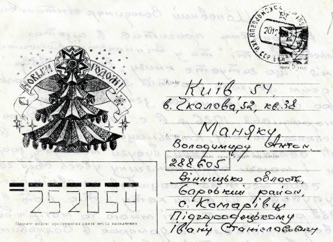
Envelope: Yes
Number of pages: 3
Keywords: Ukraine--History--Famine, 1932-1933--Personal narratives; Famines--Ukraine--History--Sources; Famine victims; Holodomor; Голодомор; perpetrators; food requisitioning; grain requisitioning; survival strategies; food substitution; collective farm; family mortality; mass mortality; multinational village; burial.
Notes: Abridged and edited transcription of Ivan Pidhorodetsky’s letter is published in 33ii: holod: Narodna Knyha-Memorial. Kyiv: Radiansky pysmennyk, 1991, p. 62-63.
Accession Number: 2007.2 -1014


SYNOPSIS

The UCRDC depends on voluntary donations – both individual and institutional - for its financing.
It provides receipts for tax purposes.


-
‣Home
Ivan Pidhorodetsky was born circa 1927 in the village of Haluzyntsi in Derazhnia raion of Vinnytsia oblast (currently Khmelnytsky oblast). He remembers how in 1932 a commission made up of activists came to their home to entice his father to join the collective farm. Father, in the absence of his wife at home, agreed and surrendered his agricultural equipment. When his wife and Ivan’s mother came home, she made him get his equipment back. In a few days, the commission returned, and this time, they confiscated all the equipment, a horse, grain and even food that they found in pots.
With very little left to eat, the family began starving by the spring of 1933. They started using the corn stalk and snails as food substitutes. Ivan’s father ended up sending him to the village of Komarivtsi in Bar raion, Vinnytsia oblast, to live with his maternal grandmother. Shortly after that, Ivan’s father, who was 35 at the time, and his paternal grandmother died. He attended his father’s funeral, which was also attended by about a dozen people. Ivan recalls that about ten people were dying daily in Haluzyntsi, a village with a population of over 1,000. He estimates that a few hundred people died there in 1933. Ivan lived the rest of his life in Komarivtsi. Decades later, he returned to Haluzyntsi but could not locate his father’s grave and was shocked that the house in which his family used to live looked like Taras Shevchenko’s house, with the roof made of hay, fifty years after the events of the Holodomor.
Pidhorodetsky mentions that he used to believe the official propaganda about happy life in the Soviet Union. Then he read that the famine was created artificially and kept questioning why thousands of Ukrainian grain producers were killed and whether the famine was so bad in his village because it was multiethnic, with about half of the village population composed of Ukrainian Poles.