


Full Name in Ukrainian: Василь Єгорович Панченко
Full Name in English: Vasyl Panchenko
Data of Birth: Circa 1926
Place of Birth: Zlynkai
Raion: Mala Vyska raion (currently Novoukrainka raion)
Oblast: Odesa oblast (currently Kirovohrad oblast)
Country: Ukraine
Copy of original: Yes
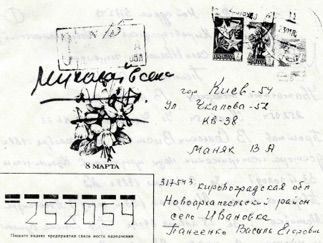
Envelope: Yes
Number of pages: 8
Keywords: Ukraine--History--Famine, 1932-1933--Personal narratives; Famines--Ukraine--History--Sources; Famine victims; Holodomor; child; family mortality; Голодомор; perpetrators; forced labor; survival strategies; 1937 political repressions; arrest; persecution; food stamps.
Notes: This letter is written in Russian. Abridged letter is published in 33: holod. Narodna Knyha-Memorial, Kyiv: Radiansky pysmennyk, 1991, p.437.
Accession Number: 2007.2 -5004


SYNOPSIS

The UCRDC depends on voluntary donations – both individual and institutional - for its financing.
It provides receipts for tax purposes.


-
‣Home
Vasyl Panchenko was eight at the start of the Holodomor. He writes in response to some of the letters that he read in the newspaper Silski Visti. He feels obliged to object to Stalin’s apologists who praise Stalin and themselves.
Panchenko was one of five children in the family. In 1932, his father was a tractor driver in the village of Zlynka, Mala Vyska raion, Odesa oblast. He was awarded a special sheaf of wheat for his outstanding work. When Panchenko’s father became ill, the family moved to the village of Novomariivka, Bratske raion, Odesa oblast (currently in Voznesensk raion, Mykolaiv oblast), where they rented a house, while his father worked as a branch manager on a “Bolshevik” soviet farm (radhosp) in Novoukrainka raion.
In 1933, a search brigade came to their family home while Panchenko’s father was at work. The brigade took away everything, even the sheaf of wheat that Panchenko’s father was awarded for his outstanding work. Panchenko’s father turned to his work for help with food but received none. He came home exhausted, sat down to rest outside his house, by the fence, and the body collectors picked him up. They took him to the cemetery, weak but still alive, threw him in a mass grave and buried him.
Panchenko was the oldest child in the family and helped his mother collect the previous year’s frozen potatoes from the fields. His mother made pancakes with frozen potatoes and millet husk, but this was not enough to save his youngest brother and sister. They died. Then the fields were plowed for sowing (in the spring of 1933), and there were no more potatoes left to salvage. The remaining children dispersed to forage for weeds and whatever grain they could find, even in horse manure. When their father died, they were driven out of their house and ended up living in a banya.
Then their mother went missing, and some man took Vasyl and his older brother to Zinovievsk (currently Kropyvnytsky). He left them near a church where they were later picked up and taken to orphanage number 1 [in the same city]. (Their sister stayed in the village hoping to find their mother). Then the boys were transferred to an orphanage in Novomyrhorod and went to a school in the village of Porpurivka (Novomyrhorod raion) in 1936-1939. Panchenko recalls how he avoided looking at the children who had parents and would bring bread to school for their lunch.
After finishing school, Panchenko struggled, alone and without a home. He worked in a soviet farm and then went to study at a factory apprenticeship school (FZU). Later he worked as a tractor driver on a soviet farm in Kazakhstan. Even as a tractor driver, he was extremely poor, with hardly any clothes, and wore wooden clogs, which was very embarrassing. He was also entitled to a ration in a diner which included no more than 200 gr of bread a day. He was drafted into the army during WWII and received a distinction for his service. The only highlight of his life was that in 1950 he found his mother and sister, whom he had believed to be dead. They lived in Novoukrainka. His mother worked as a milkmaid at a soviet farm for 35 years and experienced her share of misery and hardship.
Panchenko concludes the letter with a question to Stalin’s apologists: why were millions of innocent people, entire families, dying of hunger while there were piles of stored grain rotting in distant villages? Why were hardworking people being buried alive? What possible justification or legal grounds could there be for such actions? He mentions that tears are running from his eyes as he writes his letter.