


Full Name in Ukrainian: Віра Ілларіонівна Медведєва; (Вера Илларионовна Медведева)
Full Name in English: Vira Medvedieva
Data of Birth: 1920
Place of Birth: Novooleksandrivka
Raion: Mezhova raion (currently Dnipro raion)
Oblast: Dnipropetrovsk oblast
Country: Ukraine
Copy of original: Yes
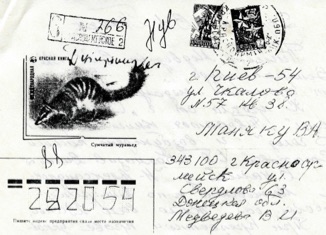
Envelope: Yes
Number of pages: 6
Keywords: Ukraine--History--Famine, 1932-1933--Personal narratives; Famines--Ukraine--History--Sources; Famine victims; Holodomor; child; family mortality; Голодомор; perpetrators; forced labor; survival strategies; 1937 political repressions; arrest; persecution; food stamps.
Notes: This letter is written in Russian. Abridged and edited version of Vira Medvedieva’s letter is published in 33ii: holod. Narodna Knyha-Memorial, Kyiv: Radiansky pysmennyk, 1991, p.177-178.
Accession Number: 2007.2-8006


SYNOPSIS

The UCRDC depends on voluntary donations – both individual and institutional - for its financing.
It provides receipts for tax purposes.


-
‣Home
Vira Medvedieva was born in 1920. She survived the Holodomor in her native village of Nooleksandrivka, Mezhova raion, Dnipropetrovsk oblast (currently Dnipro raion, Dnipropetrovsk oblast) and Chervonoarmiisk (currently Pokrovsk, Donetsk oblast). She writes in response to the letter of O. Stakhova, former activist of a search brigade, that appeared in the newspaper Silski Visti.
Medvedieva calls “activists” lazy troublemakers, like a man from her village by the name of Hlushchenko - a small-time thief before he became an activist and a snitch and compares them to the hard-working people in her village and elsewhere, who were starving and dying during the Holodomor.
Hlushchenko collaborated with the White Army and objected to the creation of a collective farm. But then he started calling himself a representative of the Soviet government in the village and many households that he allegedly reported to the authorities were dekurkulized and deported. Others were sent to perform forced labor at an industrial construction site in Yenakiieve or at the construction of a power plant near Dnipropetrovsk, where many died of hard exhausting work. Medvedieva mentions that she read a document in which even middle peasants were slated to be prosecuted for failing to fulfill grain procurement quotas.
Medvedieva’s uncle and his eight grandchildren and her mother’s father and mother died during the Holodomor. Her father was “given” some work in Chervonoarmiisk (likely current Pokrovsk, Donetsk oblast) for which he received a food stamp for 400 gm of bread daily. It was not enough for a family of six. Medvedieva’s mother was ill, swollen and required surgery. However, she had to work as house help – carrying water for 3-4 km, doing laundry and washing floors - for the recipient of two food stamps per person in exchange for a “leftover slice of bread”. These people were considered “partisans” (likely she means the ones who fought for the Red Army cause) and were doing well trading at the local markets.
Vira herself had been through a lot. She mentions that, many times, she fainted while standing in [bread] lines, suffered when stipends were cancelled in 1940 and survived WWII.
Medvedieva’s father was arrested as an “enemy of the people” in 1937. After his arrest, his picture was taken down from an honorary board displaying pictures of stakhanovites, the exemplary Soviet workers. She writes that she knows and has met a few times a witness in her father’s trial, Kishchyk, who used to work with her father, and investigator Khaliava, who “outdid himself” [in fabricating her father’s case].