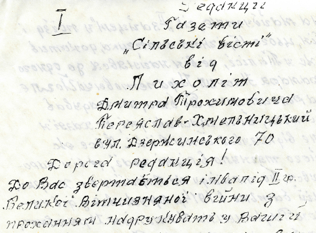



Full Name in Ukrainian: Дмитро Трохимович Лихоліт; Дмитро Лихоліт
Full Name in English: Dmytro Trokhymovych Lykholit
Data of Birth: 1923
Place of Birth: Khotsky
Raion: Pereiaslav raion (currently Boryspil raion)
Oblast: Kyiv oblast
Country: Ukraine
Copy of original: Yes
Envelope: Yes
Number of pages: 11
Keywords: Ukraine--History--Famine, 1932-1933--Personal narratives; Famines--Ukraine--History--Sources; Famine victims; Holodomor; Голодомор; mass mortality; search brigades; requisitioning; dispossession; burial; burial brigades; cannibalism; food substitution; survival strategies; barter; Torgsin; travel for food to Belarus; 1937 political repressions.
Notes: Abridged and edited transcription of Dmytro Lykholit’s letter is published in 33ii: holod: Narodna Knyha-Memorial. Kyiv: Radiansky pysmennyk, 1991, p. 239.
Accession Number: 2007.2 - 4012


SYNOPSIS

The UCRDC depends on voluntary donations – both individual and institutional - for its financing.
It provides receipts for tax purposes.


-
‣Home
Dmytro Lykholit describes events in the village of Khotsky in Pereiaslav raion (currently in Boryspil raion) of Kyiv oblast. He was born in 1923 into the family which he describes as poor. They lived in a small house covered with straw. He had a younger sister, Katia. His father Trokhym (b. 1889) was a WWI veteran. Only during the NEP they were given some land and acquired a cow, a pig and a horse.
Lykholit recalls that, once “dekulakization” began, possessions were taken from the affected “kulak” families and auctioned off for dimes. The local church was taken apart and the icons were burned. In the fall of 1932, new requisitioning quotas were imposed on every household which had already fulfilled their earlier procurement quotas. After that, a search brigade of 10-12 activists came searching for any remaining foodstuffs. Mass starvation began in 1933 that led to mass deaths in the village.
Lykholit describes in gruesome detail how the mass burials were handled by the men assigned to pick up and bury dead bodies and how routine these improper burials became. Dmytro and his father got swollen and Dmytro’s mother and sister became extremely thin. His father heard that in Kyiv people could buy a pound of bread per person. He collected his war medals and his wife’s gold earrings and went to Kyiv. The journey was perilous. He got robbed of the earrings by some criminals but managed to bring three pounds of flour home, where Dmytro and Katya almost died after consuming pancakes made of corn cobbs. The parents dipped Dmytro and Katya in hot water that was supposed to help “cure” their stomachs and then fed them with tiny bits of bread. The children survived.
Shortly after, Dmytro and his father secretly crossed to Belarus with a scroll of homespun textile that they exchanged for a bottle of milk. They spent some time in Belarus in search of food and work. They cooked potato peels in a chipped clay pot that people gave them. Trokhym worked for some time on a barge on the Besed river. Eventually, they returned home, where Dmytro’s mother and sister were alive and treated them to a borscht made from weeds and sorrel. The reunited family then relocated to “Tymashivka” (likely Tymoshevsk) in Krasnodar region in Russia, and returned home to Khotsky only at the end of 1936.
Dmytro recalls the political terror of 1937, when the NKVD’s “black crows” were picking up people in the village branded as “enemies of the people” every night. The students in school were crossing off authors from their readers as “enemies of the people” the same time as Dmytro was reciting from the village club’s stage a poem about finding happiness (under Stalin's rule).