


Full Name in Ukrainian: Киля Кононівна Кудинова (Берлизева); Киля Кононовна Кудинова (рос.)
Full Name in English: Kylia Kudynova (née Berlyzеva)
Data of Birth: Circa 1919
Place of Birth: Rubanivka
Raion: Velyka Lepetykha raion (currently Kakhovka raion)
Oblast: Dnipropetrovsk oblast (currently Kherson oblast)
Country: Ukraine
Copy of original: Yes
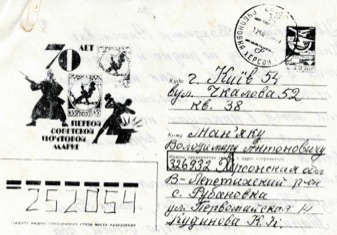
Envelope: Yes
Number of pages: 11
Keywords: Ukraine--History--Famine, 1932-1933--Personal narratives; Famines--Ukraine--History--Sources; Famine victims; Holodomor; family mortality; Голодомор; search brigades; perpetrators; burial; barter; church; orphan; cow; pets; horses; cannibalism; food substitution; requisitioning; burial; buried alive; devastation; acts of kindness; ration in school; ration in college; teacher.
Notes: This letter is written in Russian. Abridged letter is published in 33: holod. Narodna Knyha-Memorial, Kyiv: Radiansky pysmennyk, 1991, p.190.


SYNOPSIS

The UCRDC depends on voluntary donations – both individual and institutional - for its financing.
It provides receipts for tax purposes.


-
‣Home
Kylia Kudynova (née Kylia Berlyzеva) was born in 1919. She describes the events of the Holodomor in the village of Rubanivka, Kakhovka raion, Kharson oblast (Velyka Lepetykha raion, Dnipropetrovsk oblast at the time).
Kudynova was the oldest child in a family with six children. She had two brothers and three sisters. She is the only Holodomor survivor in her family.
The Berlysev family was rather poor, but they had a cow which was critical to the family’s survival. They did not have enough grain to fulfill the grain procurement quota, and a search brigade came to look for hidden grain. They took away “everything edible” - beets, pumpkins, potatoes, beans, peas, and even kitchenware such as pots and pitchers, checking even if there was any cooked food in them. The search brigade also took away the cow, which ended up in the yard of the search brigade leader, Pylyp Zelenin, who lived next door. The children could see her through the window. They cried asking where they would get milk now. After the activists left, Kudynova’s father said that the family should be prepared to die. They tried to survive on mock substitute foods made of weeds and frozen potatoes. However, they soon became swollen and died one by one, starting with the youngest children.
Kylia and her mother survived until the new harvest but then the mother died, too, leaving Kylia a complete orphan. As an orphan, she was entitled to a breakfast in school, which was better than nothing but quite meager. Kudynova’s girlfriend Olena Pakhomova helped her survive. Olena’s brother worked as a storehouse keeper. She would bring Kylia a fistful of flour and they would cook it into a gruel.
The dead in Rubanivka were picked up by a burial brigade and buried “like dogs” – without clothes or coffins. One time, Kudynova’s mother found a woman on their property who was barely alive. She contacted the village council, hoping to find the woman’s relatives. Instead, the burial brigade came to pick up the woman and buried her while she was still alive. And that was not the only time when this happened.
Before the Holodomor, Rubanivka was a large and bountiful village of 25,000 people with gardens and vineyards. It had two village councils – one for the Ukrainian community, and another one for the Russian. In 1933, the village became desolate, overgrown with weeds. Empty (vacant) houses everywhere. Kylia’s family, like many others, sold everything they had in the house “for a glass of sour milk or buttermilk”. There were many people ready to take advantage of the starving who in turn were eager to sell their possessions for some food. Two beautiful churches in the village were taken apart and taken away.
Kudynova blames the grain procurement commissar (upovnovazheny) Savransky for “doing everything possible to starve people to death,” for the vicious extermination of 35,000 horses in Rubanivka, and for the taking away of cows. Starving peasants ate all their pets and there were cases of familial cannibalism in the village. At the same time, there was a huge barn full of grain in the middle of Rubanivka with enough grain to feed more than one village. Kudinova believes that those who did this were “communists” only in name. She calls them “Stalin’s dogs,” “bandits” and “enemies of the people”.
After finishing grade 7, Kudynova began working on the collective farm. The work was extremely difficult. “The real communists,” such as the head of the collective farm Yakov Moskaliov, persuaded her to study in a veterinary college as a stepping stone towards studying in a pedagogical college, which was her dream. She had only one dress and no shoes when she arrived at the college, but as a student she began receiving a ration and a stipend, with which was eventually able to buy a coat and some canvas shoes.
Kudynova retired after working as a teacher for 30 years. She has a family and believes that she lives in relative prosperity. She is grateful for the “good life” that the [current] government created for her and others. The only thing that she lacks is good health, because of severe deprivation and grief during her childhood and youth.