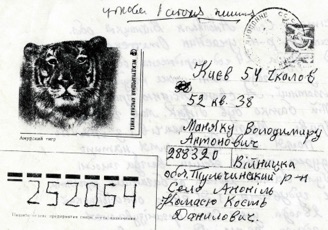



Full Name in Ukrainian: Кость Данилович Комасюк
Full Name in English: Kost Komasiuk; Kost Danylovych Komasiuk
Data of Birth: 1924
Place of Birth: Hannopil
Raion: Tulchyn raion
Oblast: Vinnytsia oblast
Country: Ukraine
Copy of original: Yes
Envelope: Yes
Number of pages: 4
Keywords: Ukraine--History--Famine, 1932-1933--Personal narratives; Famines--Ukraine--History--Sources; Famine victims; Holodomor; Голодомор; search brigade; requisitioning; collectivization; dekulakization; dekurkulization; eviction; act of kindness; imprisonment; survival strategies; child labour; illiterate; WWII; ration; 1946-1947 famine; poverty; taxes; deprivation
Notes: An abridged and edited version of Kost Komasiuk’s letter is published in 33ii: Holod: Narodna Knyha-Memorial. Kyiv: Radiansky pysmennyk, 1991, p.133.
Accession Number: 2007.2 -1032


SYNOPSIS

The UCRDC depends on voluntary donations – both individual and institutional - for its financing.
It provides receipts for tax purposes.


-
‣Home
Kost Komasiuk was born in 1924. He survived the Holodomor in the village of Hannopil in Tulchyn raion of Vinnytsia oblast. He had four siblings and completed only one year of school education in 1938.
Komasiuk describes his parents as poor, with only 2 hectares of land, and making ends meet by working for the “rich.” His mother refused to join any “collectives” (early forms of collective farming) because the “rich” people were telling her that those “collectives” are “hell.” As a result, in March of 1932, their family was “dekurkulized.” A search brigade took all their grain, left only some potatoes “in a pit,” and arrested Kost’s father, who got sentenced to five years in jail. In May of 1932, the search brigade came back to take away the potatoes. Komasiuk’s mother could not stand it. She attacked the members of the brigade – broke one’s head and another’s leg, and ran away, all the way to Moldavia (currently Moldova). The five children were kicked out of their house. Only a few weeks later, some commissar was passing through the village, took pity on them, and ordered to let children back into their home.
Kost’s two little brothers died by 1935, and in 1936. Once his big sister turned 16, she joined the collective farm. Kost worked as a pig shepherd. His parents – a disabled father and the missing mother – came back home shortly. Komasiuk was ruled not suited for the military service because of a childhood injury to his feet. During WWII, he survived the Romanian occupation, hiding from the occupiers. In March 1944 he joined the Soviet Army, became a sergeant and an artillery man, and fought until the end of the war in Europe that found him in Graz.
Even after the war, he suffered from the 1946-1947 famine that killed his father. He struggled to find a decent employment and escape poverty, but his war-time injuries and, later, tuberculosis rendered him a disabled person with a pension of just 15 rubles in 1963. His letter is a testament to his life-long suffering and deprivation.