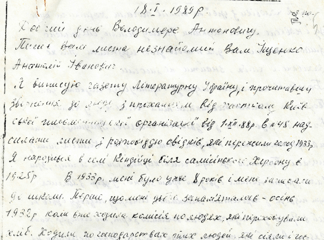



Full Name in Ukrainian: Анатолій Іванович Іщенко
Full Name in English: Аnatolii Ishchenko
Data of Birth: 1925
Place of Birth: Kindiika
Raion: Сurrently part of the city of Kherson
Oblast: Odesa oblast (currently Kherson oblast)
Country: Ukraine
Copy of original: Yes
Envelope: No
Number of pages: 17
Keywords: Ukraine--History--Famine, 1932-1933--Personal narratives; Famines--Ukraine--History--Sources; Famine victims; Holodomor; Голодомор; collectivization; kulaks; kurkuls; dekulakization; durkurkulization; perpetrators; activists; requisitioning; food substitution; survival strategies; ration; torture; cows; horses; poverty; childhood; TSOZ; Torgsin; propaganda and agitation; Russification; persecution.
Notes: Abridged and edited transcription of Anatolii Ischenko’s letter is published in Holod: 33ii: Narodna Knyha-Memorial. Kyiv: Radiansky pysmennyk, 1991, pp. 379-380.
Accession Number: 2007.2-5012


SYNOPSIS

The UCRDC depends on voluntary donations – both individual and institutional - for its financing.
It provides receipts for tax purposes.


-
‣Home
Anatolii Ishchenko was born in 1925 in the village of Kindiivka (Odesa oblast at the time). The village is currently part of the city of Kherson.
His memoir details activities of a commission tasked with the grain requisitioning from the people “who were hiding grain.” The head of this commission, “representative” Balabanov, was sent from Kherson, and four other members were local activists. Anatolii clearly witnessed some of the searches, as well as heard details of other activities of the commission from his father, Ivan Ishchenko, born in 1900. Ivan was a great believer in the soviet system, and liked to talk about it to his fellow-villagers. After graduating from “political education” course, he was appointed head of the village council and, as such, became a member of the commission, a de-facto search brigade, for some time. Ivan Ishchenko was eventually kicked out of his position and commission by Balabanov because he had showed compassion to the potential victims of searches and had no stomach for witnessing the torture that was applied to the “kurkuls” suspected of hiding valuables. He found a different job in a state farm (radhosp) but never again spoke to other people about the benefits of the new political order or the reasons for quitting the village council and the commission. The search brigade members were particularly zealous, not only in searching for grain but also in taking away everything from the subjects of their searches – clothes, footwear, gold and silver. If the head of the household was not in, they would arrest his wife, leaving the orphaned children behind. One of the brigade’s members named Senka Gridin was not local and personally executed Balabanov’s order to torture a “kulak.” Ishchenko also describes a propaganda show staged in the village by the activists and portraying the symbolic burying of the local kurkuls.
Among other subjects discussed by Ishchenko in his letter in some detail, is the working of the SOZ (short of TSOZ, Tovarystvo spilnoi obrobky zemli (Ukr.) - Association for the Joint Cultivation of Land), an early form of collective farming, where rations were used as a means of forcing starving people to commit to joining SOZ. He also mentions how the fear of being branded as kurkuls forced even the middling peasants to demolish auxiliary buildings on their homesteads. Among other things that were demolished in the village were four or five windmills, replaced by a steam windmill which was not sufficiently productive to serve the needs of the whole village.
Ishchenko also offers his reflections on the shortcomings of the Ukrainian national elites and the Russification of Ukraine under Brezhnev. He sent a letter protesting the Russification of Ukraine to the republican Communist party’s central committee in Kyiv in 1972. He claims that after that, until his retirement in 1986, he was a subject of surveillance and provocations at his workplace - the Illichivsk shipbuilding plant.